

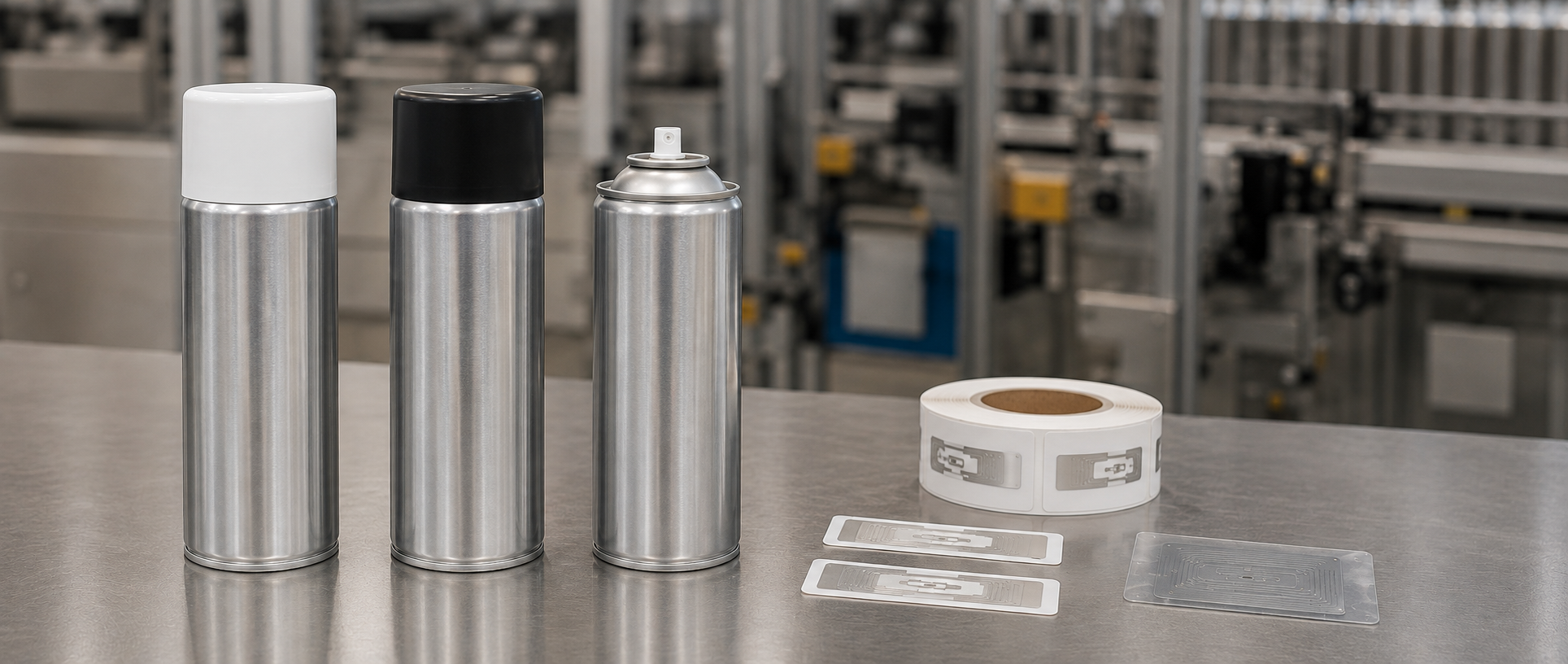
Radio frequency identification technology comes in multiple formats, frequencies, and form factors. High-frequency and ultra-high-frequency tags behave differently, read differently, and are suited to different environments and retail ecosystems.
For contract manufacturers, the challenge is not just applying an RFID label. The challenge is applying the right RFID solution in a way that performs reliably and can be repeated at production scale. A compliant label that does not read consistently, slows down the line, or creates packaging issues is not really a solution.
RFID implementation is particularly complex in aerosol packaging because metal interferes with signal performance. Aerosol cans create constraints that are very different from non-metal packaging, and those constraints directly affect tag selection and label placement.
That means RFID cannot be treated as an afterthought. The type of label, where it is applied on the container, and how it interacts with the product inside all factor into which approach makes sense for a given SKU. The solution has to be engineered around the realities of the package and the production environment. A contract manufacturer that offers only one RFID configuration is offering a workaround, not a solution.
Customers do not always come to us with a fully developed plan. Sometimes they have a clear specification. Sometimes they are still trying to interpret a retailer mandate and understand what it means for their packaging program.
We work through the requirement, identify what is actually being asked, and develop a path forward that fits both the compliance need and the realities of manufacturing. We evaluate tag type and placement early in the packaging process, coordinate with label suppliers, and validate read performance before product ships.
Because we handle labeling as part of an integrated manufacturing process rather than as an afterthought, we can catch signal interference issues, placement problems, and compliance gaps before they become your problem at the dock door.
In contract manufacturing, flexibility is often misunderstood. It does not mean saying yes to every request without questioning whether it will work. It means understanding the end requirement, anticipating the production challenges, and designing a solution that meets both.
Some customers come to us with a fully specified RFID requirement. Others are responding to a new retailer mandate and are figuring it out in real time. Some have products that present labeling challenges because of container geometry or formulation. We meet customers wherever they are in that process.
That is especially important when a customer is under time pressure. Retail mandates do not leave much room for trial and error. Customers need a manufacturing partner who can assess the requirement, identify the risks early, and implement a process that works before product reaches the dock.
RFID requirements are becoming more common across retail and distribution channels, and they are only becoming more so. Brands need more than a label application vendor to meet them. They need a contract manufacturing partner who can interpret the mandate, account for packaging constraints, and deliver a solution that is both compliant and manufacturable.
If your team is evaluating RFID requirements for an aerosol product, the conversation should start earlier than final packaging. The right solution depends on more than the tag itself. If you have questions about how RFID fits into your packaging program, I am happy to talk through it.