

Kitting and specialty packaging is the work that happens after a product is filled and before it reaches a shelf or a customer's door. That includes building multi-SKU kits and bundles, assembling promotional packs, and finishing a product in a retail-ready format like a blister card or a display carton.
It's a separate service from filling, and it's also separate from the labeling and RFID work we've covered elsewhere. A product can be filled at Chem-Pak, filled somewhere else, or already sitting in a warehouse, and still come to us just for this last step.
Most of what comes through kitting falls into a handful of common formats.
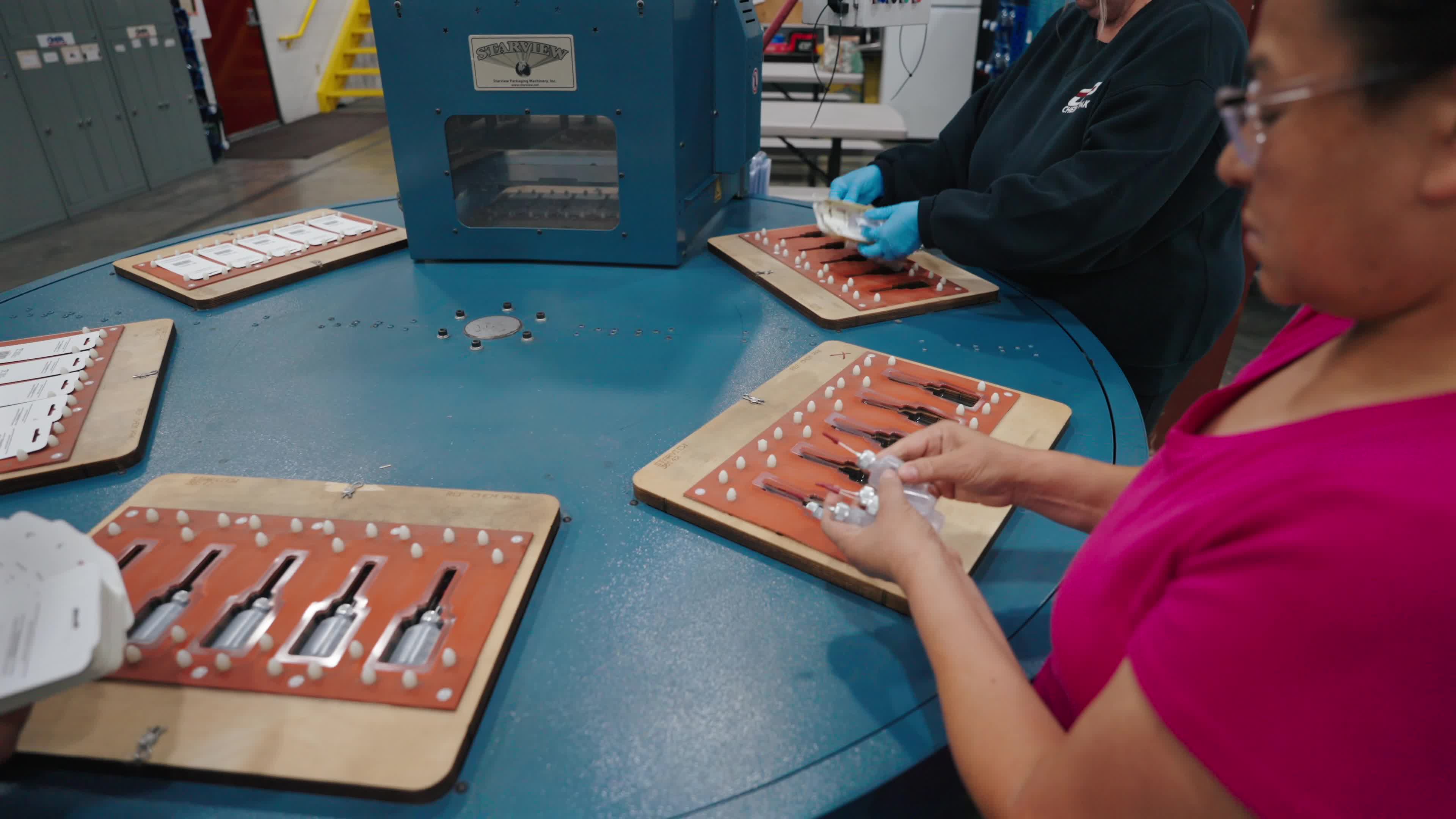
Clamshells, blisters, and trap blisters. These are the sealed plastic packaging formats you see hanging on a pegboard at a hardware store or auto parts retailer. We run a rotary Starview blister-sealing system for this work, which handles both standard blister sealing and trap blister formats where the product sits in a molded tray under a printed card.
Variety packs and multi-SKU kits. When a brand wants to bundle several products together, whether that's a seasonal promotion or a permanent multi-pack SKU, kitting is where those individual units get combined into one sellable unit.
Retail display cartons and PDQs. PDQ stands for "pretty darn quick," and it's the industry term for a pre-packed display carton that a retail associate can drop straight onto a shelf or endcap without unpacking individual units first.
Shrink wrap, shrink sleeves, and neck bands. These serve two different purposes. Shrink wrap is common for bundling multiple units together or for tamper-evidence on a single unit. Shrink sleeves and neck bands are more often about compliance labeling or finishing touches on individual containers.
Not every kitting job needs the same approach, and that's by design. Automated blister sealing makes sense for high-volume, standardized runs where the format doesn't change from batch to batch. Manual assembly makes more sense for shorter promotional runs, non-standard bundle configurations, or kits that combine products with different shapes and sizes that don't move cleanly through automated equipment.
Being able to run both under one roof means a brand isn't forced to over-invest in automation for a short promotional run, or stuck without capacity when a program scales up.
This connects directly to a question we get from a lot of private label brands: once the product is filled and labeled, what does it take to actually get it retail-ready? For brands building a multi-SKU line, or bundling products into a starter kit or gift set, that packaging step is often just as important to the launch timeline as the formulation itself.
It also matters for brands with seasonal or promotional programs. A holiday variety pack or a limited-time bundle doesn't need a permanent packaging line investment. It needs a partner who can run that format for the length of the promotion and then move on to the next one.
Coordinating a separate packaging vendor after filling adds a handoff, and every handoff is a place where a schedule can slip. Product has to ship to a second facility, sit in a queue, get run, and ship again before it reaches the retailer. That adds freight, adds time, and adds another point of contact to manage.
Running kitting and specialty packaging alongside filling and production means one quality system and one team tracking the product from raw material to the finished, retail-ready case. For a brand managing a launch timeline, fewer handoffs is usually the difference between hitting a retail date and missing it.
At Chem-Pak, we can handle the entire process, from formulation to packaging, so what reaches your customers is a finished product you're proud to put your name on.
If you already have a product filled and just need it finished for retail, our specialty packaging and kitting page covers the full range of formats and equipment. If you're earlier in the process and still working out your packaging plan alongside formulation and production, our LaunchPath framework is built to bring those conversations together from the start instead of treating packaging as an afterthought.
What's the difference between kitting and contract packaging?
Kitting specifically refers to assembling multiple products or components into one sellable unit, like a bundle or variety pack. Contract packaging is the broader category that also includes single-unit formats like blister cards, shrink sleeves, and retail display cartons.
Does my product need to be filled at Chem-Pak to use your kitting services?
No. Kitting and specialty packaging can be used as a standalone service for a product filled elsewhere, though running it alongside production means fewer handoffs and a single point of contact.
What retail packaging formats can Chem-Pak produce?
Clamshells, blisters, trap blisters, variety packs, retail display cartons and PDQs, shrink wrap, shrink sleeves, and neck bands, supported by both manual assembly and a rotary Starview blister-sealing system.
Is kitting relevant for private label brands?
Yes. A lot of private label and multi-SKU brands need their finished products bundled, kitted, or packaged for retail before launch, and that step is often just as time-sensitive as the production run itself.
Dave Nesselrodte is Production Manager at Chem-Pak, Inc., overseeing aerosol and liquid manufacturing operations from batching through final shipment.